
Contact Columbus Door Sales Today!
Thank you! Your submission has been received!
Oops! Something went wrong while submitting the form.

Patio doors play an important role in connecting indoor living spaces with the outdoors while allowing natural light to flow throughout the home. The right doors can improve ventilation, enhance curb appeal, and increase the overall functionality of your living area. With many styles, materials, and energy-efficient options available, selecting the right one requires thoughtful consideration. Design preferences, durability, and security features also influence the decision. In this blog, we will explore key factors to consider when selecting patio doors that best suit your home’s style, space, and practical needs.
A new patio door can completely transform how your kitchen, dining area, or living room feels. Expansive glass surfaces flood interior room space with natural light, making rooms feel larger and more inviting while connecting you visually to your garden, deck, or outdoor living space. For many homeowners, upgrading from an old door to a modern system is one of the most impactful improvements they can make.
If you’re dealing with an aluminum slider from the 1980s that sticks on its track, fogged double-pane glass that blocks your view, persistent drafts around the threshold, or locks that feel flimsy, you’re experiencing problems that were common with older door technology. Those early sliders used cheap nylon rollers and single-pane glass with poor insulation values around R-2.0—far below what modern doors deliver.
Choosing the right patio door isn’t just about curb appeal or matching your home’s architectural design. It directly affects daily comfort, security against forced entry, monthly energy bills, and even resale value—some markets see 5-10% price increases for homes with quality patio access. This guide walks you through door types, frame materials, energy performance, space planning, and project budgeting so you can make a confident decision.
Before browsing styles or materials, think about how your household actually uses—or will use—the door for your home. Lifestyle and daily traffic patterns are the first filter that helps narrow your options.
Consider these common scenarios:
Furniture layout matters too. If your TV sits opposite the patio wall or your dining table crowds the door swing path, you’ll want a space-saving design like sliding doors rather than hinged patio doors that require a 5-7 ft clear radius.
Here’s a practical comparison: a 2020-built open-plan kitchen with a 12 ft opening might use multi-slide doors that pocket into walls, leaving the island and dining area unobstructed. Meanwhile, a 1960s semi-detached home with an 8x10 ft dining nook works perfectly with a 6 ft slider that doesn’t encroach on the limited floor space.

Modern patio doors fall into four main categories: sliding, hinged French, bifold, and multi-slide. Each suits different wall widths, ceiling heights, and outdoor spaces, and mixing types within one home can still look cohesive when you match frame colors and hardware finishes. If you’re debating between sliding vs folding patio doors specifically, space constraints and how wide you want the opening to feel will be two of your biggest deciding factors.
The sections below break down pros, cons, typical sizes, and best-use cases so you can quickly identify which door type fits your situation.
Standard sliding patio doors typically come in 2-panel configurations starting at 5 ft or 6 ft wide, scaling up to 4-panel units around 12 ft wide with heights from 6.5 to 8 ft. One panel remains a stationary panel while the other glides on tandem rollers supporting 200-800 lbs per panel, and many homeowners weigh these against French vs sliding patio doors when deciding which style best fits their space and design preferences.
Advantages of gliding doors:
Sliding doors hold 40-50% market share because of their versatility across various home sizes. They’re ideal for townhomes, condos, small patios, and any situation where a swinging door would create furniture conflicts.
Modern upgrades include multi-point locking systems, integrated blinds operable between the panes, and low-profile sills under 0.75 inches for ADA compliance. Frame color options now include white, black frames, bronze, and various foiled woodgrain finishes, stable for 25+ years.
Classic French doors feature two or more panels that swing in or out, typically in 5 ft or 6 ft openings with options for sidelites extending to 10 ft on wider walls. They mount on 3-hinge setups with multipoint locks engaging every 10-12 inches.
The traditional appeal of hinged doors comes from wider stiles and rails that suit period homes, cottages, and traditional brick houses. They complement traditional architecture and offer a timeless aesthetic that many homeowners prefer over the modern look of sliding glass.
Inswing vs. outswing considerations:
Hinged patio doors require clear swing space—measure furniture clearance and deck rail distances carefully. They typically cost more than basic sliders, especially with custom finishes or grille patterns mimicking Georgian bars, depending on configuration.
Bi-fold patio doors consist of 3-8+ panels that accordion to one or both sides, commonly installed on 9-16 ft openings. Individual panels range from 700-1200mm wide (up to 1.5m in premium systems.
When fully open, bifolds create a wide opening and unobstructed connection between indoor and outdoor spaces, perfect for poolside verandas, covered patios, or homes with flush indoor-outdoor flooring. They’ve grown 25% in popularity since 2015, when renovations embraced open-plan living.
Best contexts for bifolds:
Trade-offs include higher cost, more complex installation requiring plumb openings within 1/4 inch, and proper drainage to prevent water pooling. Traffic doors—a single operable panel for everyday use, add convenience so you don’t accordion the entire system just to let the dog out.
Multi-slide doors and oversized sliders function as “moving glass walls” for expansive openings 12-30+ ft wide and up to 9-10 ft high in typical residential builds. These premium systems offer 90% glass-to-frame ratios in brands like Cero by Solarlux or Vitrocsa.
Panel operation options:
These doors demand engineered headers supporting 500-1,000 lbs per linear foot, making them most common in new construction or major extensions. Heavy-duty trolleys handle 1,000+ lb capacities for smooth, easy operation despite their size.
Compared to bifolds, multi-slide systems offer cleaner sightlines (36mm vs 120mm interlocks) and more glass area, but require more careful structural planning. They excel at delivering dramatic views, luxury ambiance, and exceptional airflow—though large glass expanses need consideration for shading and glazing to prevent overheating.
Even the perfect patio door type fails if there isn’t enough room to open it comfortably or if daily circulation gets blocked. Before finalizing your choice, evaluate both interior and exterior clearances carefully.
Interior considerations:
Exterior considerations:
For hinged doors, decide swing direction—left vs. right, in vs. out—based on your specific layout. Inswing handles snow loads up to 20 psf but needs interior clearance, while outswing leverages patio depth in smaller 10x12 ft rooms.
A practical comparison: a 6 ft slider on a second-floor balcony maximizes limited depth without blocking the space, while an 8 ft French door set works beautifully opening onto a ground-level patio with ample outdoor room.
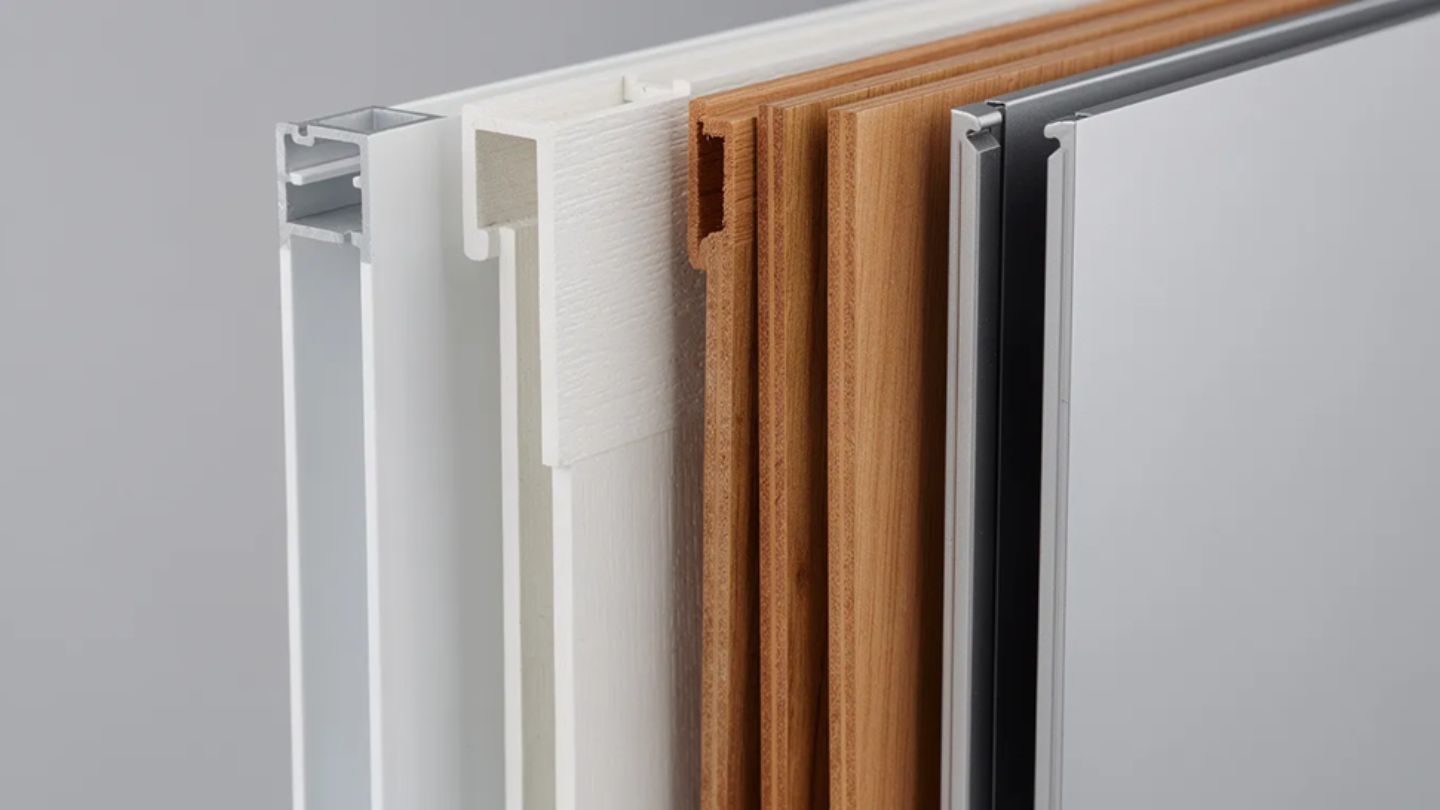
Frame material affects appearance, maintenance requirements, upfront cost, and long-term energy efficiency. Your local climate—humid, coastal, cold, or hot—should heavily influence this decision alongside your home’s style and preferred maintenance level, and a broader patio door buying guide for homeowners can help you balance these factors with budget and aesthetic goals.
The main residential frame materials include vinyl, fiberglass, aluminum, wood, and composite or clad-wood systems. Each brings different strengths to different situations.
Vinyl doors have dominated replacement patio doors for twenty years, holding roughly 50% market share. They offer an excellent combination of value and performance for most homeowners.
Fiberglass frames are strong, dimensionally stable from -20°F to 150°F, and can mimic painted wood without regular refinishing. They’ve become increasingly popular in harsh climates with freeze-thaw cycles and coastal areas.
Expect 20-40% higher upfront cost compared with vinyl doors, but the longer life expectancy and better dimensional stability often justify the investment. Many mid-to-high-end patio door systems in 2024 use fiberglass or fiberglass-clad frames, especially for large openings.
Real wood interiors—pine, oak, mahogany—appeal to traditional or high-end homes where custom stains and paint colors matter. The warmth and character of natural wood remain unmatched for certain architectural styles.
Clad wood doors solve the exterior maintenance problem by wrapping the outside in aluminum or fiberglass while keeping natural wood on the interior. Premium products like Pella Impervia offer 30+ year durability when properly maintained, though they come at a higher price point, typically starting around $5,000.
Pure aluminum doors deliver slim sightlines as narrow as 1 inch, creating a modern aesthetic popular in contemporary architecture and very large openings. Their strength-to-weight ratio allows spanning 20+ ft without bulky frames.
Hybrid or composite frames combine materials—like aluminum exterior with timber interior—offering the best of both worlds. Brands like Centor deliver timber warmth inside with aluminum’s durability outside. 2024 trends favor foiled woodgrain aluminum finishes (Liniar Alumina, Origin OB-72) that stay stable 25+ years without fading.
Glass makes up 80-90% of a patio door’s surface area, so energy-efficient performance and daily comfort depend heavily on glazing choices. Understanding your options helps you balance budget with performance while also considering the importance of security features in patio doors, since stronger glass and hardware can dramatically reduce vulnerability to break-ins.
Glazing basics:
|
Feature |
Standard Option |
Premium Option |
Benefit |
|
Panes |
Double (2) |
Triple (3) |
Better insulation |
|
Gas Fill |
Argon |
Krypton |
Improved U-factor |
|
Coatings |
Standard Low E |
Multiple Low E coatings |
Heat reflection |
|
Spacers |
Aluminum |
Warm-edge |
Reduced edge condensation |
Low-e glass uses microscopic metallic coatings that reflect up to 70% of infrared heat while allowing visible light through. Combined with argon or krypton gas fills between panes, modern doors achieve U-factors as low as 0.18-0.25—dramatically better energy efficiency than older single-pane doors.
Climate-specific choices:
Look for ENERGY STAR certification or NFRC ratings that match your climate zone. These ratings predict real-world performance and potential for lower energy bills.
Additional comfort features include laminated glass that blocks 99% of UV rays and dampens noise by 30-35 dB, plus integrated blinds (PowerView styles) that automate via smartphone apps for glare control and privacy—especially valuable for doors in full sun.
Modern patio doors can be remarkably secure and quiet when specified with appropriate hardware and glass. Don’t overlook these practical considerations in your decision.
Security hardware options:
For homes near busy roads, rail lines, or schools, acoustic laminated glass reduces traffic noise by up to 40 dB—a meaningful improvement for sleep quality and daily comfort. This added security and noise control can transform how you experience your outdoor spaces.
Maintenance for optimal performance:
|
Task |
Frequency |
Benefit |
|
Vacuum slider tracks |
Start of spring |
Prevents 90% of jams |
|
Lubricate rollers with silicone |
Annually |
Extends life 2x |
|
Check weatherstripping |
Annually |
Seals 95% of drafts |
|
Refinish wood frames |
Every 2 years |
Protects against UV/moisture |
|
Clean glass and frames |
Quarterly |
Maintains appearance |
Quality vinyl doors and fiberglass doors require very little maintenance compared to wood, making them popular for homeowners who prefer easy maintenance without sacrificing performance. A simple spring cleaning routine keeps most doors operating smoothly for decades.
Understanding realistic costs helps you shop confidently and avoid surprises. Here are typical 2024-2025 installed price ranges:
What drives price:
Retrofit vs. full-frame installation:
Professional installation prevents 70% of post-installation issues like leaks and drafts. Quality installers align frames to within 1/8 inch plumb and apply proper flashing per WDMA standards. Always verify installer credentials and ask about both product warranties (20-30 years typical) and workmanship guarantees (10 years ideal).
Combining your preferred style with the practical considerations covered above puts you on the path to finding the perfect patio door. Here’s a straightforward approach to move forward confidently.
Step-by-step project checklist:
When evaluating quotes, compare apples to apples: same door type, similar glass packages, equivalent warranties. Ask specifically about product warranties and workmanship guarantees—quality installers stand behind both.
Your final checklist should include: door type, frame material, glass package (double vs. triple, low-e specifications), color/finish, hardware style, security options, and accessibility features if needed.
With a clear plan in hand, finding the right patio door becomes a manageable decision rather than an overwhelming one. Most homeowners find that once they understand their options, the choice becomes surprisingly straightforward.
Selecting the perfect patio doors can greatly enhance your home’s comfort, natural light, and overall style. By considering materials, energy efficiency, security features, and design options, homeowners can choose doors that improve accessibility and outdoor views while adding long-term value and functionality to their living spaces.
Columbus Door Sales helps homeowners find high-quality patio doors in Powell designed to improve both appearance and performance for nearby homeowners. We provide residential solutions, including residential door service and repair, and garage doors, to support reliable and attractive home entry systems. Contact us today to explore patio door options and receive expert guidance for your home.
Quality vinyl doors and fiberglass doors typically last 20-30 years with proper maintenance, while high-end clad wood doors can exceed 40 years if maintained with periodic refinishing. Harsh climates, poor installation, and lack of basic maintenance can shorten these lifespans significantly. Watch for warning signs like condensation between panes (indicating seal failure), persistent drafts exceeding 0.1 cfm/sq ft, sticking operation, or visible frame damage—these indicate it’s time to consider a replacement patio door.
Enlarging an opening is often possible but requires structural work, including a new header engineered to support 2x the original load in many cases. This is more common in major remodels or additions and adds high cost and complexity compared to a same-size replacement. Before planning to upgrade from a 6 ft slider to a 12 ft bifold or multi-slide, consult a qualified contractor or structural engineer—most will provide an assessment to determine feasibility and approximate additional costs.
Retrofit (insert) replacement fits a new door into your existing frame, making it less invasive and more budget-friendly—typically saving 20-30% versus full replacement. Full-frame replacement removes the entire old frame and trims down to the rough opening, allowing inspection for hidden water damage or rot while maximizing glass area. Choose full-frame when there’s structural damage, when you want to change door size or style significantly, or when improving insulation around the opening is a priority.
Integrated blinds stay cleaner since they’re protected from dust, pets, and children, and they offer convenient privacy and light control via tilt-wand operation or motorized systems. Trade-offs include added cost, potentially limiting some glass upgrade options, and requiring specialist repair if the blind mechanism fails. They’re ideal for doors in full sun or high-traffic areas where external blinds or curtains would be impractical or constantly damaged.
.jpg)


